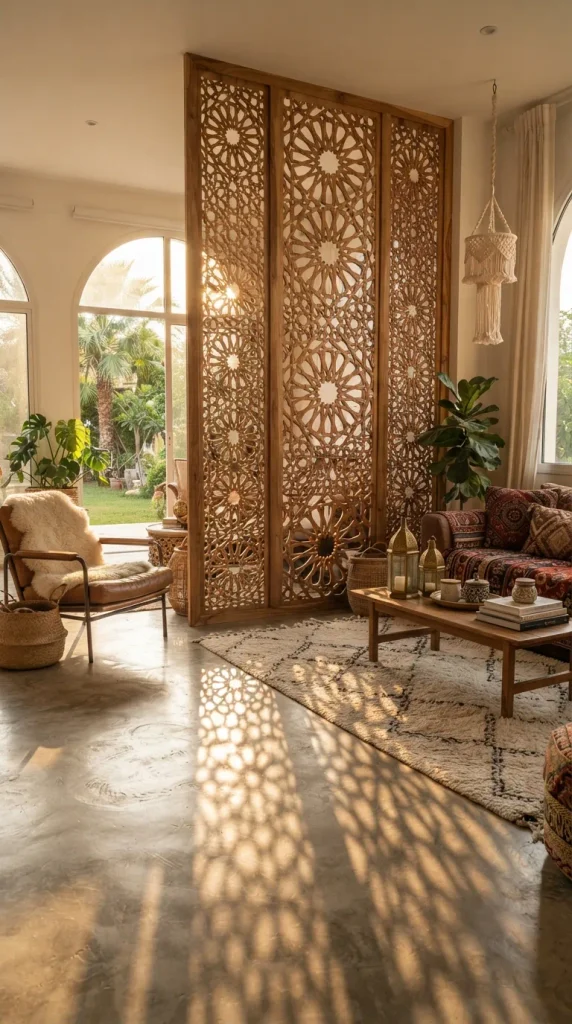
5. CNC-Carved Wooden Geometric Lattice (Jali Screen)
Introduction
Lattice screens, inspired by traditional Indian Jali and Middle Eastern Mashrabiya architecture, offer intricate micro-shadows and ventilation. Modern CNC carving allows these historical patterns to be executed in contemporary geometric forms.
What This Idea Means
A decorative wood panel featuring intricate, repeating geometric or organic cutouts. It functions as a lightweight partition that diffuses sunlight, maintains air circulation, and provides semi-private spatial zoning.
How to Make It
- Select high-density hardwood plywood (such as Baltic Birch or Walnut-veneered MDF) in 3/4-inch thickness to prevent panel warping.
- Design or select a geometric vector pattern and cut using a CNC router or laser cutting service.
- Sand the micro-edges of every cutout meticulously using sanding sponges and flap wheels.
- Construct a solid hardwood perimeter frame with an internal routed groove sized to receive the 3/4-inch carved panel.
- Insert the carved panel into the frame groove, securing with interior wood glue and concealed pin nails.
- Install floor-to-ceiling pivot pins or attach directly to surrounding structural walls using concealed mounting brackets.
- Finish with sprayed matte clear lacquer to evenly coat internal cutout crevices without pooling.
Tips and Variations
- Pattern Scale: Opt for dense micro-patterns in bedrooms for greater privacy, and expansive macro-geometric patterns in living areas for maximum light transmission.
- Dual Layering: Sandwich a translucent rice paper or frosted acrylic sheet between two identical carved wood panels for an illuminated lantern effect.
Materials & Tools Needed
- 3/4-inch Baltic Birch plywood panel or walnut-veneered MDF
- Solid hardwood framing lumber (2×2 or 2×3 stock)
- Router with 3/4-inch straight slot-cutting bit
- Fine sanding sponges and detail finishing files
- HVLP spray gun or high-grade aerosol lacquer
- Mounting brackets or vertical pivot hardware