Modern embroidery hoop art bridges the tactile warmth of traditional handcraft with the clean geometry, intentional palettes, and organic minimalism of contemporary interior styling. Instead of traditional, crowded samplers, modern hoop art uses negative space, mixed textures, botanical realism, architectural lines, and unexpected fabric grounds to create finished wall hangings and tabletop accents.
Whether curated on a gallery wall or set on a studio shelf, each finished piece brings bespoke texture into a living space.
1. Minimalist Architectural Line Art
Introduction
Architectural line art distills grand structures, mid-century facades, and minimalist archways into pure, linear stitchwork. It celebrates structure, perspective, and clean geometric rhythm.
What This Idea Means
This style translates urban landscapes, historic porticos, or Scandinavian window frames into continuous thread work. It relies heavily on unstitched negative space to suggest scale and light, letting the simplicity of a continuous line speak for itself against neutral woven linen.
How to Make It
- Base Fabric: Crisp off-white or natural oatmeal linen stretched drum-tight.
- Transfer: Trace clean geometric line art using a water-soluble transfer pen or iron-on stabilizer.
- Stitching: Use 2 strands of matte black stranded cotton. Work a crisp backstitch or fine stem stitch along every architectural edge, ensuring stitch lengths remain consistent on long straight runs.
- Finishing: Frame in a light raw beechwood hoop, tightening the screw firmly and trimming the reverse with felt.
Tips & Variations
- Keep line tensions completely uniform to prevent the fabric from puckering along long vertical lines.
- Swap standard black floss for deep charcoal, burnished bronze, or navy blue to complement your room’s metal accents.
- Add subtle architectural depth by filling a single curved doorway or windowpane with a pale terracotta or sage satin stitch.
2. Dimensional French Knot Meadow
Introduction
A tactile celebration of wild florals, this design transforms flat fabric into a dense, pillowy terrain of textured botanical blossoms.
What This Idea Means
The French Knot Meadow focuses entirely on surface depth. By clustering hundreds of tiny raised knots together, it mimics the undulating blooms of wild lavender, chamomile, and prairie grasses swaying across a hillside.
How to Make It
- Base Fabric: Earthy moss-green or warm sand-colored cotton canvas.
- Background: Lightly draft organic, drifting swaths across the bottom half of the hoop.
- Stitching: Use 3 to 6 strands of embroidery floss in an array of ochre, cream, blush, and lavender. Work dense clusters of French knots (wrapping the needle 2 to 3 times) along the base, letting them scatter and thin out toward the upper edge. Use single-strand straight stitches for fine stems.
- Finishing: Mount in a dark walnut-stained bamboo hoop.
Tips & Variations
- Mix floss finishes by pairing matte cotton with subtle mercerized or silk threads for light-catching dimension.
- Vary your knot size by combining 2-strand and 6-strand knots side by side to give the meadow natural biological variation.
- Leave the upper half of the fabric completely raw to represent an open sky.

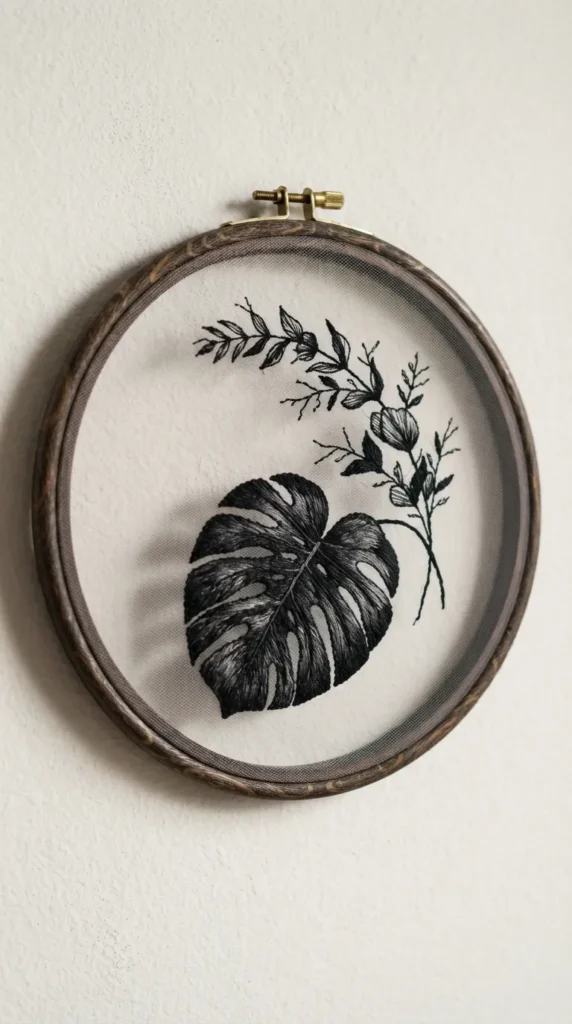
3. Sheer Botanical Tulle Embroidery
Introduction
Stitching directly onto sheer illusion tulle creates ethereal botanical art that appears to float effortlessly within the hoop.
What This Idea Means
Tulle hoop art challenges traditional opaque backings. By suspending detailed leaves, ferns, and delicate petals on transparent netting, the design interacts directly with the wall behind it, casting subtle shadows in changing daylight.
How to Make It
- Base Fabric: Two taut layers of fine nylon dress tulle in clear, soft ivory, or smoky grey.
- Stabilizing: Pin water-soluble stabilizer printed with your botanical design directly to the back of the double-tulle layer.
- Stitching: Use 1 to 2 strands of floss. Carefully embroider using split stitches, leaf stitches, and long-and-short satin stitches. Maintain light tension so the delicate mesh does not warp.
- Finishing: Rinse gently in tepid water to dissolve the stabilizer completely, let dry flat, and retension in a pale bamboo hoop.
Tips & Variations
- Keep all needle travel on the backside strictly hidden underneath the solid stitched areas since the reverse is visible through transparent mesh.
- Choose high-contrast botanical motifs like monstera leaves, eucalyptus sprigs, or wild ferns.
- Layer two different colored tulle circles (e.g., pale peach over sheer lavender) for an iridescent background hue.

4. Abstract Textured Color Block
Introduction
Embracing modernist and Bauhaus aesthetics, abstract color blocking pairs flat planes of vibrant color with intensely textured stitched zones.
What This Idea Means
This piece treats the hoop like a modern canvas, playing with proportion, organic shapes, and contrasting fiber weights. It combines smooth surface stitches with heavy textures to create a study in tactile form.
How to Make It
- Base Fabric: Heavy unbleached cotton duck cloth.
- Layout: Sketch 3 to 4 intersecting organic blobs, semicircles, and angled blocks.
- Stitching: Fill one block with horizontal satin stitch, another with thick loop stitches or Turkey work, and a third with diagonal seed stitches. Incorporate tapestry wool alongside standard stranded cotton for varying pile heights.
- Finishing: Secure within an unfinished circular wooden hoop.
Tips & Variations
- Stick to a focused color scheme of 3 to 4 tones, such as mustard yellow, dusty terracotta, soft slate, and cream.
- Use a craft punch needle on select sections to create dense loops alongside fine flat hand embroidery.
- Leave one organic shape completely unstitched, showcasing the raw linen weave as its own structural element.

5. Raw Linen Constellation & Moon Phase
Introduction
Celestial embroidery translates the night sky into metallic accents set against deep, unrefined textiles.
What This Idea Means
This design captures the quiet geometry of the cosmos. It maps out astronomical star charts, lunar cycles, or personal zodiac configurations using delicate metallic thread work that glints when catching the light.
How to Make It
- Base Fabric: Charcoal, midnight blue, or raw slubbed flax linen.
- Drafting: Use a fine chalk pencil to plot precise lunar circles and constellation coordinate dots.
- Stitching: Stitch full and crescent moons using smooth white and silver satin stitch. Connect constellation stars using single-strand silver or pale gold metallic thread in fine running stitches, finishing major star junctions with seed beads or French knots.
- Finishing: Mount inside a hoop painted in matte matte-black or finished with antique wax.
Tips & Variations
- Metallic thread can fray easily; coat threads lightly with beeswax or thread conditioner before stitching.
- Use tiny mother-of-pearl or glass seed beads at primary constellation nodes for genuine sparkle.
- Incorporate subtle watercolor washes of indigo on the linen prior to stitching to mimic nebular dust clouds.

6. Monochromatic Raised Stumpwork
Introduction
Stumpwork is a three-dimensional hand embroidery technique where elements are wired, padded, and raised off the background fabric.
What This Idea Means
Modern stumpwork moves away from historical figurines and focuses on sculptural, monochromatic forms. By working in a single tone—such as pure chalk white or stone grey—the art highlights relief, light, and physical shadow.
How to Make It
- Base Fabric: Sturdy white twill or heavy linen.
- Padding: Create wired petal and leaf slips by stitching satin stitch over fine millinery wire on a separate hoop, trimming them, and anchoring them into the main piece. Build raised relief using layered felt padding beneath satin stitches.
- Stitching: Work entirely in white stranded floss, varying matte, silk, and wool threads across the raised forms.
- Finishing: Display in a wide-rimmed, modern blonde wood hoop.
Tips & Variations
- Keep floss completely clean by washing hands frequently and working in a dust-free space.
- Monochromatic designs rely on strong directional lighting; position your finished hoop near an angled lamp or natural window light.
- Create geometric relief instead of floral petals by layering geometric felt pads underneath straight surface stitches.


7. Moody Velvet & Metallic Wildflowers
Introduction
Pairing the rich sheen of velvet with shimmering metallic threads creates opulent, vintage-inspired hoop art.
What This Idea Means
This style brings rich depth to botanical themes. The light-absorbing nap of deep jewel-toned velvet provides a dramatic background for light-reflecting metallic stems and dried wildflower silhouettes.
How to Make It
- Base Fabric: Stretched cotton or silk velvet in emerald green, midnight blue, or burgundy.
- Stabilizing: Back the velvet with light cotton muslin to prevent stretching. Trace designs onto water-soluble transfer film applied to the top nap.
- Stitching: Use antique gold, copper, and bronze metallic threads. Stitch slender wildflower silhouettes—such as wild allium, thistles, and wheat heads—using feather stitches, fly stitches, and detached chain stitches.
- Finishing: Frame in an antique brass-plated brass hoop or a warm oak hoop.
Tips & Variations
- Avoid overtightening the hoop hardware directly over bare velvet to prevent crush marks on the velvet pile; pad the inner hoop with soft bias tape.
- Use smooth, unstranded metallic cord or braided filament to reduce snagging against the fabric pile.
- Add tiny raw gemstone beads (like pyrite or garnet chips) along the center of your floral seed heads.
8. Continuous Single-Line Portrait
Introduction
Drawing inspiration from modern contour drawings, single-line portrait embroidery translates figurative art into unbroken thread paths.
What This Idea Means
Continuous line portraiture celebrates human form through fluidity and restraint. The entire face or silhouette is suggested in one uninterrupted stroke, offering an understated and expressive modern aesthetic.
How to Make It
- Base Fabric: Plain unbleached calico or smooth linen-cotton blend.
- Design: Draw or source a continuous-line silhouette, transferring it carefully to preserve every curve.
- Stitching: Use 2 or 3 strands of deep brown or black floss. Work in small, even split stitches or a fine whipped backstitch to maintain a seamless, unbroken stroke across sharp turns.
- Finishing: Mount in an oval natural wood hoop to complement the natural curves of the portrait.
Tips & Variations
- Keep your stitches short on sharp turns (like the tip of a nose or curl of a lip) to keep curves clean.
- Add a soft, abstract watercolor wash behind the portrait before stitching to provide subtle skin-tone accents.
- Work the line in a warm copper or golden floss against a dark navy canvas for an inverted look.
9. Modern Ombré Sunset Landscape
Introduction
A vibrant study in gradients, this design captures atmospheric golden-hour horizons using horizontal thread blending.
What This Idea Means
Ombré landscapes reinterpret desert vistas, mountain silhouettes, and calm ocean sunsets into continuous horizontal fields of blended color, creating an evocative and warming composition.
How to Make It
- Base Fabric: Medium-weight neutral linen.
- Pattern: Lightly map out horizontal gradient zones with a ruler and gentle curved lines for hills.
- Stitching: Use long-and-short stitch to blend 6 to 8 shades of floss—transitioning from deep plum at the crown through burnt orange, saffron yellow, dusty peach, down to sand. Keep stitches staggered to achieve a seamless blend.
- Finishing: Stitch a clean silhouette of mountain ranges or palm leaves at the bottom in solid black, then secure in a clean pine hoop.
Tips & Variations
- To make gradients blend naturally, feather your long-and-short stitches into the preceding color zone by at least 3 to 4 millimeters.
- Use variegated embroidery floss along with solid shades for effortless tonal transitions.
- Frame with a minimalist square frame around the circular hoop for a stylish gallery presentation.
10. Botanical Fern Terrarium
Introduction
Capturing lush indoor greenery within glass boundaries, terrarium hoop art frames intricate woodland botanical specimens inside stylized geometric shapes.
What This Idea Means
This idea combines structured architectural glass frames with wild, organic foliage. It plays on the popular indoor plant aesthetic, locking delicate fronds inside crisp, diamond- or dome-shaped outlines.
How to Make It
- Base Fabric: Pale cream linen or fine homespun cotton.
- Framing Outline: Stitch a faceted geometric polygon or bell-jar outline using 3 strands of dark graphite or metallic gold backstitch.
- Interior Greenery: Fill the interior with layered fern branches, maidenhair fronds, and hanging ivy using fishbone stitch, fly stitch, and detached chain loops in shades of moss, olive, and forest green.
- Finishing: Allow a few fern tips to break outward past the geometric frame to give the composition movement. Mount in a light maple hoop.
Tips & Variations
- Stitch soil and pebble layers at the base using assorted French knots and bullions in grey and charcoal.
- Add highlights on the “glass” panels using faint, single-strand white straight stitches angled across the terrarium frame.
- Incorporate subtle bead accents on cascading vines to resemble water droplets.
11. Thread-Painted Realistic Avian Portrait
Introduction
Thread painting (silk shading) uses fine, single-strand stitches to produce realistic portraits of birds with feathered textures and rich coloration.
What This Idea Means
This advanced technique treats fine embroidery thread like oil paint. By laying single strands in directional flows, the needle mimics individual feather tracts, downy chests, and the glossy catchlight of a songbird’s eye.
How to Make It
- Base Fabric: Tight-weave linen or heavy silk dupioni securely stretched.
- Drafting: Trace a high-resolution bird study with clear feather direction indicators.
- Stitching: Work entirely in single-strand stranded cotton. Follow the natural grain of plumage with closely packed long-and-short stitches, blending tonal values from highlight to shadow. Stitch the eye with high-sheen black silk, leaving a crisp white micro-stitch catchlight.
- Finishing: Perch the stitched bird upon a real dried twig securely sewn directly to the base cloth, framing in a dark circular hoop.
Tips & Variations
- Change thread directions faithfully across the crown and breast to capture how real feathers lie.
- Choose striking birds with clean, modern color palettes, such as a Bohemian Waxwing, Mountain Bluebird, or European Robin.
- Keep the surrounding canvas clean to preserve the modern, fine-art focus of the portrait.
12. Geometric Mandala & Sacred Geometry
Introduction
Precise, radial geometric designs create meditative wall art anchored in symmetry, clean mathematical lines, and balance.
What This Idea Means
Sacred geometry embroidery brings mindfulness to modern craft. Utilizing overlapping circles, concentric petals, and intricate compass marks, it produces calming centerpieces suited for modern decor.
How to Make It
- Base Fabric: Solid dark linen or indigo-dyed cotton.
- Drafting: Draw the mandala using a compass, ruler, and water-erasable white fabric pencil to ensure symmetry.
- Stitching: Use clean chain stitches, stem stitches, pistil stitches, and eyelet stitches. Work outwards from the exact center point, keeping tension completely even throughout the radial design.
- Finishing: Frame in a natural polished circular hoop, ensuring the mandala sits centered within the perimeter.
Tips & Variations
- Maintain a tight two-tone palette (such as pure white and pale gold on dark denim) for high visual clarity.
- Add tiny metallic bugle beads along the outer perimeter rays for subtle dimension.
- Work with varied thread thicknesses: 3 strands for structural bounding circles, 1 strand for intricate internal latticework.
13. Mixed-Media Watercolor & Flora
Introduction
Marrying the loose spontaneity of watercolor painting with precise hand stitching creates a dynamic interplay between soft washes and sharp, raised textures.
What This Idea Means
This hybrid craft uses delicate paint washes on fabric as an atmospheric background, while intentional embroidery brings focal blossoms, stems, and highlights into physical focus.
How to Make It
- Base Fabric: 100% natural cotton canvas or heavy linen that holds water media well.
- Painting: Apply wet-on-dry and wet-on-wet watercolor washes directly onto the stretched fabric to form abstract floral or landscape shapes. Allow to dry completely for 24 hours.
- Stitching: Select focal regions of the dried paint marks and outline them with fine embroidery. Add embroidered flower centers, petal veins, and delicate stems directly over the painted silhouettes.
- Finishing: Leave outside areas unpainted, setting the finished work in a light raw wood hoop.
Tips & Variations
- Test fabric scraps beforehand to observe how your chosen paint interacts with the fabric grain.
- Use fabric medium mixed with watercolors if you want washability, though hoop art hung as wall decor works well with traditional artist watercolors.
- Keep your embroidery selective; do not over-stitch every painted section so the underlying watercolor wash can breathe.
14. Modern Typography & Affirmation Hoops
Introduction
Modern typographic hoop art pairs clean serif, modern sans-serif, or calligraphic lettering with minimalist accents, turning meaningful phrases into interior decor.
What This Idea Means
Moving away from classic folk cross-stitch sayings, modern typography hoops rely on contemporary layout design, spacious tracking, and sophisticated font styles to bring calming messages into the home.
How to Make It
- Base Fabric: Natural flax linen or warm cream cotton.
- Typesetting: Print your phrase in a contemporary serif or minimalist sans-serif font, transferring it using a lightbox and fine tracing pen.
- Stitching: Use backstitch or stem stitch for thin hairline strokes, and compact satin stitch or padded backstitch for weighted letter components. Use 1 to 2 strands of matte black or warm espresso floss for clean edges.
- Finishing: Accent the text perimeter with a small, asymmetric olive branch or minimalist arch, framed in a smooth maple hoop.
Tips & Variations
- Keep letter edges smooth by using a sharp size 9 or 10 embroidery needle that pierces fabric cleanly without pulling the weave.
- Limit phrases to short, impactful words or affirmations (e.g., “Breathe,” “Stillness,” “Here & Now”).
- Try tone-on-tone embroidery (e.g., camel thread on warm beige linen) for an understated look.


15. Macramé-Fringed Boho Hoop Art
Introduction
Combining macramé fringe with central embroidery details adds soft movement and bohemian texture to finished wall hangings.
What This Idea Means
This design breaks beyond the circular wooden border of the hoop. By anchoring woven macramé knots, raw woven fringe, or braided cords along the lower circumference, the art transitions from flat needlework into a multidimensional textile hanging.
How to Make It
- Base Fabric: Coarse natural linen mounted securely inside an open inner hoop.
- Central Motif: Embroider a desert moon, palm fronds, or an abstract sunburst in the center of the linen canvas.
- Fringe Attachment: Cut 15 to 20 strands of 4mm single-twist macramé cotton cord. Loop them along the bottom arc of the outer wooden hoop using Lark’s Head knots.
- Finishing: Comb out the cord ends with a fine-tooth brush to create a soft, brushed fringe, and trim them into an intentional V-shape or clean horizontal line.
Tips & Variations
- Dip-dye the lower cotton fringe tips in dilute natural tea or terracotta dye baths for a subtle ombré hem.
- Add wooden beads onto selected fringe strands before combing out the ends.
- Keep the central embroidery bold and geometric so it holds its visual weight against the heavy cotton fringe below.
16. Wild Botanical Mushroom Forager Study
Introduction
Inspired by vintage field guides and modern woodland foraging, mycological hoop art brings earthy forest-floor textures, gills, and spore caps to life.
What This Idea Means
This style brings rich earthy tones and curious organic forms to the hoop. By capturing the natural curves of chanterelles, morels, and delicate field caps, it celebrates woodland flora with modern, illustrative needlework.
How to Make It
- Base Fabric: Oatmeal speckled linen or warm brown chambray.
- Drafting: Sketch 2 to 3 grouped wild mushrooms with exposed gills and mossy bases.
- Stitching: Use ribbed woven wheel stitches or fine radiating straight stitches under the mushroom caps to mimic delicate gills. Work the upper caps in smooth satin stitch or padded split stitch using rust, cream, and ochre floss. Add French knots and tiny loop stitches at the base for living moss.
- Finishing: Frame in an unvarnished oak or walnut wood hoop.
Tips & Variations
- Incorporate textured brown, ecru, and olive wool threads at the base to imitate rich woodland topsoil.
- Add subtle off-white seed beads on red mushroom caps to create a stylized fly agaric design.
- Embroider small Latin binomial species names beneath each mushroom specimen in delicate running stitch.
17. Delicate Negative-Space Silhouette
Introduction
Negative-space embroidery uses densely stitched backgrounds to reveal an untouched, blank fabric shape in the center.
What This Idea Means
Instead of stitching the subject directly, this concept stitches everything around it. The primary silhouette emerges through the surrounding thread work, creating contrast between textured stitches and smooth, unstitched fabric.
How to Make It
- Base Fabric: Soft white or natural linen.
- Outlining: Trace your central silhouette (such as a monstera leaf, soaring bird, or human profile) in the center of the hoop.
- Stitching: Keep the inside of the silhouette untouched. Completely fill the surrounding outer area with dense stitching, such as continuous seed stitches, French knots, or concentric radiating chain stitches in a single dark shade.
- Finishing: Mount in a dark-stained hoop that matches the density of the surrounding stitched area.
Tips & Variations
- Keep the boundary line of the negative silhouette crisp by working a sharp split stitch directly along the line before filling the exterior.
- Use a monochromatic palette (e.g., deep navy floss on crisp white linen) for maximum silhouette clarity.
- For an organic look, let the background stitches scatter and thin out toward the outer hoop edges.
18. Modern Geometric Sashiko Sampler
Introduction
Rooted in traditional Japanese functional embroidery, modern Sashiko hoop art uses geometric running stitches on dark fabrics to create clean, rhythmic patterns.
What This Idea Means
Sashiko highlights functional simplicity and geometric precision. Using crisp white or ecru cotton thread on deep indigo backgrounds, patterns like Asanoha (hemp leaf) or Seigaiha (waves) create contemporary, calming wall art.
How to Make It
- Base Fabric: Authentic dark indigo or midnight navy cotton cloth.
- Grid Transfer: Mark a precise grid using a water-soluble white marking pencil and ruler.
- Stitching: Use dedicated non-divisible Sashiko cotton thread or 3 to 4 strands of matte pearl cotton. Work in uniform running stitches, keeping gaps between stitches slightly shorter than the stitch lengths themselves. Let stitches meet neatly at geometric vertices without overlapping.
- Finishing: Wash away grid lines, press flat, and secure in a natural bamboo hoop.
Tips & Variations
- Use a traditional Sashiko thimble (worn in the palm) and a long Sashiko needle to load several stitches onto the needle at once for straight lines.
- Experiment with contemporary thread colors like bright chartreuse, neon coral, or metallic gold on deep navy fabric.
- Combine two different Sashiko grid patterns across a split diagonal layout on the same hoop.
19. Scandinavian Folk Art Floral
Introduction
Reimagining traditional Nordic and Slavic folk motifs, this style uses symmetrical floral medallions, stylized leaves, and warm color palettes.
What This Idea Means
Scandinavian folk hoop art simplifies classic heritage patterns into clean modern geometry. With mirrored botanical stems, tulip caps, and bird motifs, it brings cozy, artisanal charm into bright spaces.
How to Make It
- Base Fabric: Muted heather-grey linen or unbleached heavy cotton.
- Layout: Draw a strictly symmetrical central medallion with radiating floral sprigs.
- Stitching: Use lazy daisy stitches, closed fly stitches, bold satin stitches, and French knots. Stick to a classic Nordic color palette: mustard yellow, deep teal, brick red, and soft cream.
- Finishing: Frame in a light pine or natural birch hoop.
Tips & Variations
- Use a thicker floss weight (such as pearl cotton size 8) to give folk elements a bold, graphic presence.
- Keep floral shapes stylized and rounded rather than biologically realistic.
- Pair with a miniature companion hoop featuring a simplified matching motif to display as a balanced diptych.
20. Layered Double-Hoop Wreath
Introduction
The layered double-hoop wreath sets a smaller embroidered hoop inside a larger outer ring, turning the open space between them into a dimensional floral frame.
What This Idea Means
This architectural design breaks away from the single circle format. By suspending a small central embroidered hoop within a larger wooden embroidery ring, it creates an open, floating ring that can be adorned with both needlework and dried natural botanicals.
How to Make It
- Materials: One 4-inch wooden embroidery hoop and one 8-inch wooden hoop.
- Central Embroidery: Stretch natural linen across the 4-inch hoop and embroider a delicate central botanical monogram, constellation, or mini landscape.
- Assembly: Center the small hoop inside the larger 8-inch hoop, anchoring them together using invisible nylon filament or woven strands of matching embroidery floss at top, bottom, and sides.
- Accents: Wrap the outer wooden hoop with delicate sprigs of real dried baby’s breath, eucalyptus, or stitched 3D leaves.
- Finishing: Hang with a velvet or natural silk ribbon tied to the top hardware.
Tips & Variations
- Leave the space between the two hoops completely empty for an architectural, floating look.
- Paint the inner hoop a contrasting color (such as matte gold) while keeping the outer hoop natural wood.
- Stitch continuous vine trails on the inner hoop that visually line up with real dried botanicals attached to the outer frame.


