Air dry clay floral sculpting bridges fine-art ceramics and botanical design without requiring an industrial kiln. Unlike fresh-cut florals that wither within days or synthetic plastic stems that lack artisanal texture, handcrafted air dry clay bouquets offer permanent, matte-finish realism. Sculpting botanical arrangements from cold porcelain, lightweight paper clay, or standard mineral-based air dry compounds allows complete control over petal curvature, color saturation, and structural composition.
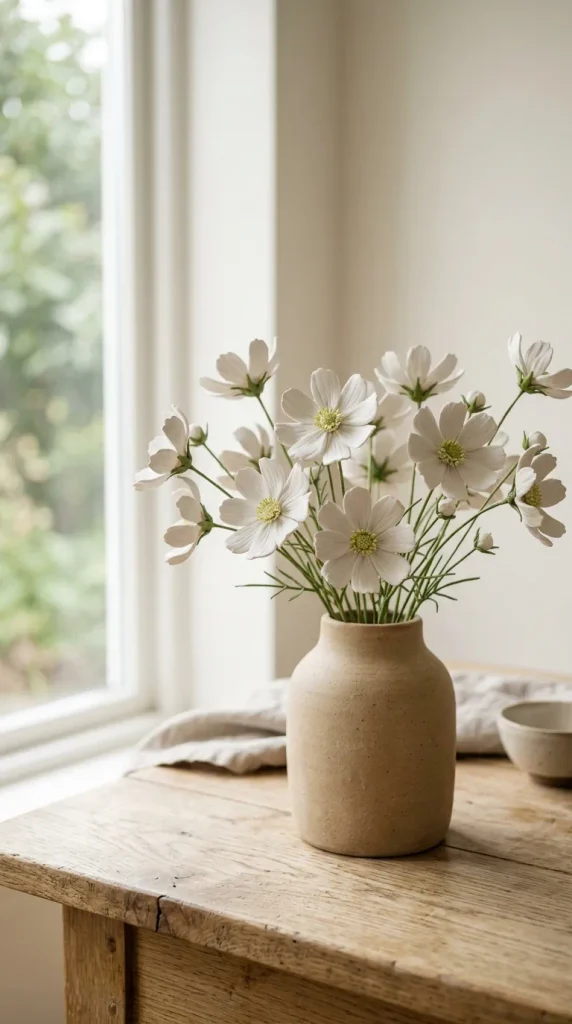
1. Minimalist Scandinavian Ethereal White Cosmos Bouquet
Scandi-inspired minimalist arrangements rely on negative space, monochromatic purity, and clean silhouettes. A monochromatic white cosmos bouquet emphasizes organic petal imperfections, delicate fluted center discs, and slender stems that complement natural ash wood and neutral linen interior spaces.
- Concept Essence: Understated organic simplicity that highlights the fragile beauty of slender white ray florets around a muted chartreuse center.
- Core Materials: Lightweight paper clay (Hearty or Modena soft), 24-gauge floral wire, pale yellow-green oil paint, matte chalk acrylic in warm white, and green floral stem tape.
- Sculpting Process:
- Roll eight teardrop-shaped balls of white clay per bloom, flattening each inside a grooved plastic veiner or against a ribbed ruler edge to create delicate longitudinal striations.
- Pinch the base of each petal and glue them radially around a small, wire-mounted central disc textured with a wire bristled brush.
- Blend water-diluted raw umber and sap green into the base floret to create organic botanical depth.
- Pro Tips & Styling Variations:
- Avoid making petals perfectly flat; drape drying petals over pencil barrels to introduce natural gentle curves.
- Pair with dried bleached bunny tails or matte-painted eucalyptus branches in an unglazed ceramic cylinder vase.
2. Antique Vintage English Tea Rose Arrangement
Vintage English cabbage roses (Rosa centifolia) showcase dense, overlapping whorls of ruffled petals with softly curled edges that mimic heirloom varieties from historic cottage gardens.
- Concept Essence: Romantic, maximalist botanical luxury built upon dense layers of cupped petals fading from deep dusty rose centers into translucent creamy rims.
- Core Materials: Cold porcelain clay, 18-gauge stem wires, floral ball stylus tools, petal veining molds, and magenta/burnt sienna soft pastels.
- Sculpting Process:
- Create a teardrop core over a hooked floral wire; wrap three small inner petals tightly around it in an interlocking spiral.
- Form 20 to 30 progressively larger petals, thinning the outer edges with a ball tool on a soft foam pad until the edges ruffle naturally.
- Apply concentric layers using craft glue, drying the bloom upside down between applications to maintain round cup volumes.
- Pro Tips & Styling Variations:
- Dust dry pigments onto petal rims prior to final sealant application to replicate antique sun-faded petal edges.
- Mix open blooms with tight, unopened round rosebuds wrapped in sepals sculpted with jagged serrations.

3. Coastal Mediterranean Wild Olive and White Anemone Mix
This arrangement balances the dramatic, dark midnight-blue central discs of crisp white anemones with the silvery-green dusty foliage of Mediterranean olive branches.
- Concept Essence: Coastal elegance pairing striking botanical contrast with muted foliage tones.
- Core Materials: Standard white air dry clay, black bead accents or ultra-dark clay, 20-gauge floral wire, olive green oil paint, and silver mica powder.
- Sculpting Process:
- Form the anemone center by flattening an indigo-tinted dome and ringing it with hundreds of tiny snips made using fine-point embroidery scissors.
- Attach five to six broad, rounded white petals directly below the fringe.
- Model lanceolate olive leaves along a wire branch, painting the underside with muted pale sage and dusting with silver-grey pigment.
- Pro Tips & Styling Variations:
- Keep the anemone stems straight and thick using floral tape wrapped around double wire cores.
- Display in an aged terracotta amphora or rough-textured stone vessel.

4. Modern Sun-Drenched Ochre & Terracotta Poppy Bundle
Inspired by high-desert landscapes, this palette trades pastel shades for rich terracotta, burnt ochre, rust orange, and dusty sienna.
- Concept Essence: Earthy, warm-toned bohemian floristry featuring crinkled papery poppy petals and distinctive ridged seed pods.
- Core Materials: Translucent resin clay, terracotta acrylic pigment, yellow ochre oil color, fine floral wire, and craft sand for texture.
- Sculpting Process:
- Press clay paper-thin between parchment paper, manually pleating the outer edges to create realistic poppy creases.
- Shape ribbed, urn-shaped central seed pods using a craft blade, topping each with an 8-point radial star stigma dusted with dark green flocking powder.
- Affix four delicate crumpled petals around each seed pod using cyanoacrylate gel.
- Pro Tips & Styling Variations:
- Craft dedicated naked poppy pods alongside blooming petals to add textural variation.
- Style in an amber glass bottle or raw travertine vase alongside dried wheat stems.

5. Moody Botanical Black Dahlia & Plum Ranunculus Cluster
Deep jewel tones and dramatic shadows evoke baroque Dutch still-life paintings with high color saturation and layered complexity.
- Concept Essence: Dark luxury featuring moody hues, dense geometric whorls, and velvet-sheen finishes.
- Core Materials: Heavy-body air dry clay, black calla acrylic dye, deep plum and dioxazine purple pigments, and satin finish sealant.
- Sculpting Process:
- Cut 40 to 60 miniature spoon-shaped petals for each ranunculus, cupping each deeply with a small 4mm ball tool.
- Build the head outward from a compact center, keeping the outer petal layers slightly flared.
- Apply deep plum base tones, then dry-brush the tips with diluted ivory paint for subtle edge illumination.
- Pro Tips & Styling Variations:
- Seal with satin lacquer rather than dead matte to create an organic, velvet-like surface sheen.
- Arrange with sculpted dark foliage like plum eucalyptus or textured black elderberry leaves.

6. Pastel Meadow Wildflower & Chamomile Posy
A casual, hand-gathered bouquet of chamomile daisies, wild lavender spikes, and field buttercups reminiscent of an English summer meadow.
- Concept Essence: Carefree, natural meadow beauty emphasizing micro-florals and varied organic silhouettes.
- Core Materials: Soft lightweight paper clay, yellow floral flocking powder, 26-gauge wires, and olive green craft paint.
- Sculpting Process:
- Roll miniature yellow domes and dip them in glue and flocking powder to create textured chamomile centers.
- Attach 12 to 14 tiny, individual white clay petals with notched tips around each center.
- Sculpt individual lavender florets and mount them in staggered whorls up 10 cm wire stems.
- Pro Tips & Styling Variations:
- Vary flower heights and lean angles across the bouquet to replicate field-gathered arrangements.
- Bind the final cluster with raw frayed silk ribbon or natural jute twine.


7. Sculptural Minimalist Calla Lily & Fan Palm Statement
Focusing on architectural lines, this arrangement uses sweeping spathes of calla lilies paired with geometric, pleated clay fan palms.
- Concept Essence: High-end architectural floristry built around dramatic silhouettes, structural simplicity, and clean negative space.
- Core Materials: High-grade cold porcelain, thick 14-gauge structural wire, golden yellow flocking, and satin white enamel paint.
- Sculpting Process:
- Form the central spadix around a wire by rolling yellow-tinted clay into an elongated cylinder textured with crosshatch cuts.
- Cut an asymmetrical spade shape from white clay, wrap it smoothly around the base of the spadix, and flare the tip outward into a sharp taper.
- Score and accordion-fold semi-circular clay sheets to form accompanying pleated spear palms.
- Pro Tips & Styling Variations:
- Reinforce the base of each calla lily with internal aluminum wire to support dramatic horizontal display angles.
- Display 3 to 5 stems in a fluted raw-concrete pedestal vase.
8. Japanese Wabi-Sabi Cherry Blossom (Sakura) Branch
This arrangement centers on the imperfect beauty of transient spring cherry blossoms, contrasting delicate pink petals against rough, woody textured clay branches.
- Concept Essence: Zen-inspired branches emphasizing natural branch angles, asymmetric clusters, and delicate seasonal beauty.
- Core Materials: Air dry wood clay (for realistic bark texture), translucent white cold porcelain, pink oil pastels, and wire armature.
- Sculpting Process:
- Sculpt thick branch armatures with air dry wood clay, carving bark fissures with a modeling needle.
- Make five-petal cherry blossoms with notched petal tips, shading the base with diluted crimson pigment.
- Cluster pairs of blossoms and tight pink buds along the node points of the branch using floral cement.
- Pro Tips & Styling Variations:
- Mix open blossoms with tight pink buds to emphasize natural seasonal transitions.
- Present as a single asymmetric branch in an off-center ceramic ikebana dish.
9. French Provencal Dusty Lavender & Eucalyptus Bundle
A classic botanical pairing combining aromatic purple lavender spikes with the silvery, rounded leaves of silver dollar eucalyptus.
- Concept Essence: Calming pastoral elegance focusing on muted purple tones, silvery greens, and rich herbal foliage textures.
- Core Materials: Standard white clay, lilac and cobalt blue pigments, silver-sage acrylic paint, and brown paper-wrapped wire.
- Sculpting Process:
- Roll dozens of tiny teardrop buds, slicing four cross-cuts at the tip of each to suggest unopened petals.
- Glue buds in ascending spiral rings around a rigid stem wire to create a tapered floral spike.
- Stamp out discs of sage-green clay, thread them centrally onto horizontal wire stems, and dust with matte white chalk.
- Pro Tips & Styling Variations:
- Add real dried lavender essential oil to the clay base during kneading for a subtle aromatic touch.
- Bundle tightly with vintage lace or display in a galvanized French zinc flower bucket.
10. Warm Ochre & Rust Sunflower Woodland Collection
A rustic arrangement spotlighting small woodland sunflowers, brown rudbeckia cones, and dried autumn elements.
- Concept Essence: Harvest warmth featuring deep golden yellows, dark chocolate central disks, and textured autumn accents.
- Core Materials: Paper clay, dark brown and golden yellow acrylics, coarse coffee grounds, and heavy gauge stem wire.
- Sculpting Process:
- Form a sturdy flat disc center, brush with PVA glue, and press into fine coffee grounds to create an organic, seed-filled texture.
- Cut two rows of pointed golden-yellow petals, crimping each base to create an alternating double layer.
- Paint the back of each flower head with a thick green calyx featuring pointed sepals.
- Pro Tips & Styling Variations:
- Slightly curl petal tips backward to give the sunflower heads realistic, dynamic posture.
- Pair with sculpted clay acorn sprigs and bronze-toned beech leaves.
11. Romantic Peony & Whispering Hydrangea Cloud
A cloud-like arrangement pairing full, lush Sarah Bernhardt peonies with delicate multi-bloom hydrangea heads.
- Concept Essence: Soft, romantic luxury defined by rounded floral silhouettes and delicate petal textures.
- Core Materials: Cold porcelain clay, soft pink and light mint oil colors, petal veiners, and flexible ball tools.
- Sculpting Process:
- Build the peony core with dense, ruffled petals, gradually adding larger, outer-flared cupped petals.
- Form hydrangea florets by stamping out hundreds of four-petal crosses, depressing their centers with a small ball tool.
- Wire hydrangea florets into small clusters of five, then bind multiple clusters together into an umbrella-shaped dome.
- Pro Tips & Styling Variations:
- Introduce subtle color shifts by blending pale apple green into the outermost peony guard petals.
- Style in a fluted glass pedestal bowl or vintage silver urn.
12. Tropical Sunset Bird of Paradise & Anthurium Array
A bold tropical centerpiece featuring the architectural angles of orange Strelitzia and glossy, heart-shaped anthurium spathes.
- Concept Essence: Bold tropical modernity pairing vivid color contrasts with clean, sculptural shapes.
- Core Materials: Resin-infused air dry clay, high-gloss clear varnish, sunset orange, royal blue, and chartreuse acrylics.
- Sculpting Process:
- Sculpt a horizontal, canoe-shaped green and purple spathe bract from clay.
- Cut brilliant orange lanceolate sepals and electric-blue petals, inserting them vertically into the central slit of the bract.
- Shape anthurium leaves with an exaggerated heart shape and pronounced veins, painting with high-gloss lacquer once dry.
- Pro Tips & Styling Variations:
- Ensure the clay dries completely before applying high-gloss coats to prevent milky surface clouding.
- Pair with broad monstera foliage sculpted from deep forest green clay.
13. Whimsical Fairytale Magnolia & Wild Fern Cascade
Evoking lush woodland floors, this design blends large, porcelain-white magnolia blooms with cascading forest ferns.
- Concept Essence: Enchanted woodland elegance balancing heavy, waxy white petals with intricate fern fronds.
- Core Materials: Heavy mineral air dry clay, satin white acrylic paint, light green floral wire, and spring-green clay.
- Sculpting Process:
- Roll thick, fleshy magnolia petals, curving them into a broad chalice shape around a spiky green central carpel.
- Cut fine, repeating pinnate leaflets along wire stems using fine cuticle scissors to form delicate fern fronds.
- Anchor blooms and ferns into a cascading wire armature that flows over vessel edges.
- Pro Tips & Styling Variations:
- Blend a tiny drop of raw umber into white clay to soften pure white into natural magnolia ivory.
- Display on high mantels or wall sconces to highlight the cascading fern lines.
14. Modern Desert Succulent & Protea Centerpiece
A water-wise botanical concept featuring architectural King Protea surrounded by velvety echeveria succulents.
- Concept Essence: Arid Southwestern luxury celebrating thick fleshy geometric rosettes and spiky protea petals.
- Core Materials: Paper clay mixed with mineral clay, dusty rose, sage green, and plum soft pastels.
- Sculpting Process:
- Shape thick succulent leaves, tapering them to sharp tips, and arrange in tight concentric spirals.
- Construct the King Protea by forming a tall woolly center and surrounding it with stiff, upward-pointing lanceolate bracts.
- Dust petal edges with plum and pale coral pastels using a soft makeup brush.
- Pro Tips & Styling Variations:
- Dust dry succulents with cornstarch or baby powder to replicate natural matte farina wax.
- Plant into a wide, low cast-iron bowl filled with decorative black river stones.


15. Royal Botanical Dutch Tulip Monoseries
A dramatic, single-variety study focused on the fluid curves and flame-like streaks of historic Rembrandt and parrot tulips.
- Concept Essence: Classic European still-life elegance showcasing twisted stems and feathered petal coloration.
- Core Materials: Cold porcelain, cadmium red, yellow ochre, and deep crimson acrylics, plus floral tape.
- Sculpting Process:
- Sculpt six elongated oval petals per flower, giving the edges irregular ruffled cuts with a craft blade.
- Hand-paint flame-like patterns radiating outward from the petal base using a fine liner brush.
- Mount on thick, pliable wire stems, bending each stem into fluid curves to simulate heavy blooms.
- Pro Tips & Styling Variations:
- Let stems cure with varied bends across curved drying surfaces to avoid rigid, straight lines.
- Display in a multi-spout blue-and-white Delft ceramic tulipier.
16. Frosted Winter White Rose & Seeded Eucalyptus Cluster
A winter arrangement featuring ivory garden roses with silvery frosted finishes, dusty blue juniper berries, and pale seeded eucalyptus.
- Concept Essence: Quiet winter elegance built on silvery pale tones, deep forest greens, and frosty textures.
- Core Materials: White paper clay, Prussian blue acrylic, translucent iridescent medium, and floral wire.
- Sculpting Process:
- Form classic garden roses from crisp white clay, keeping petal edges smooth and precise.
- Roll tiny spherical juniper berries from navy clay, coating with white chalk powder for a wild frosted look.
- Add small hanging clusters of seeded eucalyptus pods along pale sage-green wire branches.
- Pro Tips & Styling Variations:
- Lightly mist finished pieces with ultra-fine matte shimmer spray to mimic crystalline frost.
- Pair with sculpted pine cones and frosted spruce sprigs.
17. Vibrant Marigold (Genda) & Lotus Floral Harmony
Inspired by celebratory Indian traditions, this piece combines spherical golden-orange marigolds with sacred pink lotus blooms.
- Concept Essence: Festive cultural celebration highlighting dense geometric ruffles and graceful water blossoms.
- Core Materials: High-flexibility air dry clay, vibrant saffron orange, cadmium yellow, and magenta pigments.
- Sculpting Process:
- Cut hundreds of miniature scalloped circles, crimping each into a tight cone and clustering tightly into a globe.
- Sculpt wide, concave lotus petals, grading the color from white bases to magenta tips.
- Assemble the lotus around a flat, perforated green seed capsule.
- Pro Tips & Styling Variations:
- Thread marigolds without stems directly onto heavy cord to create cascading garland arrangements.
- Style in a shallow brass urli bowl alongside floating clay tea light holders.
18. Delicate Baby’s Breath (Gypsophila) & Hydrangea Sphere
An ethereal, airy arrangement constructed from hundreds of micro-buds that form a lightweight, cloud-like silhouette.
- Concept Essence: Delicate, cloud-like texture celebrating fine-art miniatures and airy negative space.
- Core Materials: Ultra-lightweight paper clay, 30-gauge fine craft wire, pale green floral tape, and PVA glue.
- Sculpting Process:
- Roll hundreds of 2mm to 3mm clay balls, pressing an 8-point star indent into each using a sharp modeling needle.
- Dip pre-cut branched wire stems into glue, pierce the clay balls, and allow to dry suspended upside down.
- Gather 20 to 30 wire stems into airy spherical pom-poms.
- Pro Tips & Styling Variations:
- Work in batches with assembly-line tools to produce the hundreds of individual florets needed efficiently.
- Display as a suspended floral cloud above a dining table using fine monofilament line.
19. Autumnal Copper Beech & Velvet Orchid Composition
A rich seasonal arrangement pairing the deep copper tones of autumn foliage with the sleek, exotic curves of moth orchids (Phalaenopsis).
- Concept Essence: High-fashion seasonal transition pairing warm autumnal leaves with tropical orchid elegance.
- Core Materials: Cold porcelain, burnt orange, raw sienna, deep burgundy oil paints, and satin acrylic medium.
- Sculpting Process:
- Form orchid blooms with two lateral petals, three dorsal sepals, and an intricate 3D central lip (labellum).
- Paint fine burgundy speckles and veins across the orchid throat using a fine detail brush.
- Stamp copper beech leaves using real leaf veiners, tinting with rich burnt orange and brown glazes.
- Pro Tips & Styling Variations:
- Curve orchid stems into sweeping natural arches weighted with internal wire.
- Present in a wide, metallic bronze ceramic trough.
20. Gothic Dried-Look Hydrangea & Faded Rose Heirlooms
This concept mimics dried preserved botanicals with brittle edges, sepia tones, and faded petal coloration.
- Concept Essence: Melancholic vintage romance capturing the quiet beauty of preserved, time-aged floral stems.
- Core Materials: Paper air dry clay, raw umber, antique cream, and sepia chalk pastels, plus ultra-matte sealant.
- Sculpting Process:
- Sculpt classic roses and hydrangea heads, deliberately curling petal edges irregularly.
- Mix tea-stain colored washes using burnt umber, raw sienna, and olive green to coat all surfaces.
- Use dry pastels to shade petal edges with deep brown, simulating aged, dried botanical specimens.
- Pro Tips & Styling Variations:
- Tear or notch petal edges randomly before drying to mimic the fragile nature of dried botanicals.
- Display in an antique brown apothecary jar or aged brass container.


